
Software remains central to venture capital but it is no longer a sufficient condition. The scarce part is shifting.
For the last decade, the cleanest venture opportunities were often software businesses with low marginal cost, fast distribution and strong gross margins. That logic still matters. But the next five years look different.
The largest opportunities are increasingly forming around physical and strategic bottlenecks:
Defence needs faster development cycles.
Space needs usable intelligence, not only more satellites.
AI needs power, chips, cooling and grid access.
Factories need automation.
Governments need sovereign capability.
These are not pure software markets. They are markets where software, hardware, infrastructure and procurement meet.
That makes them harder to build in. It also makes the best companies harder to replace.
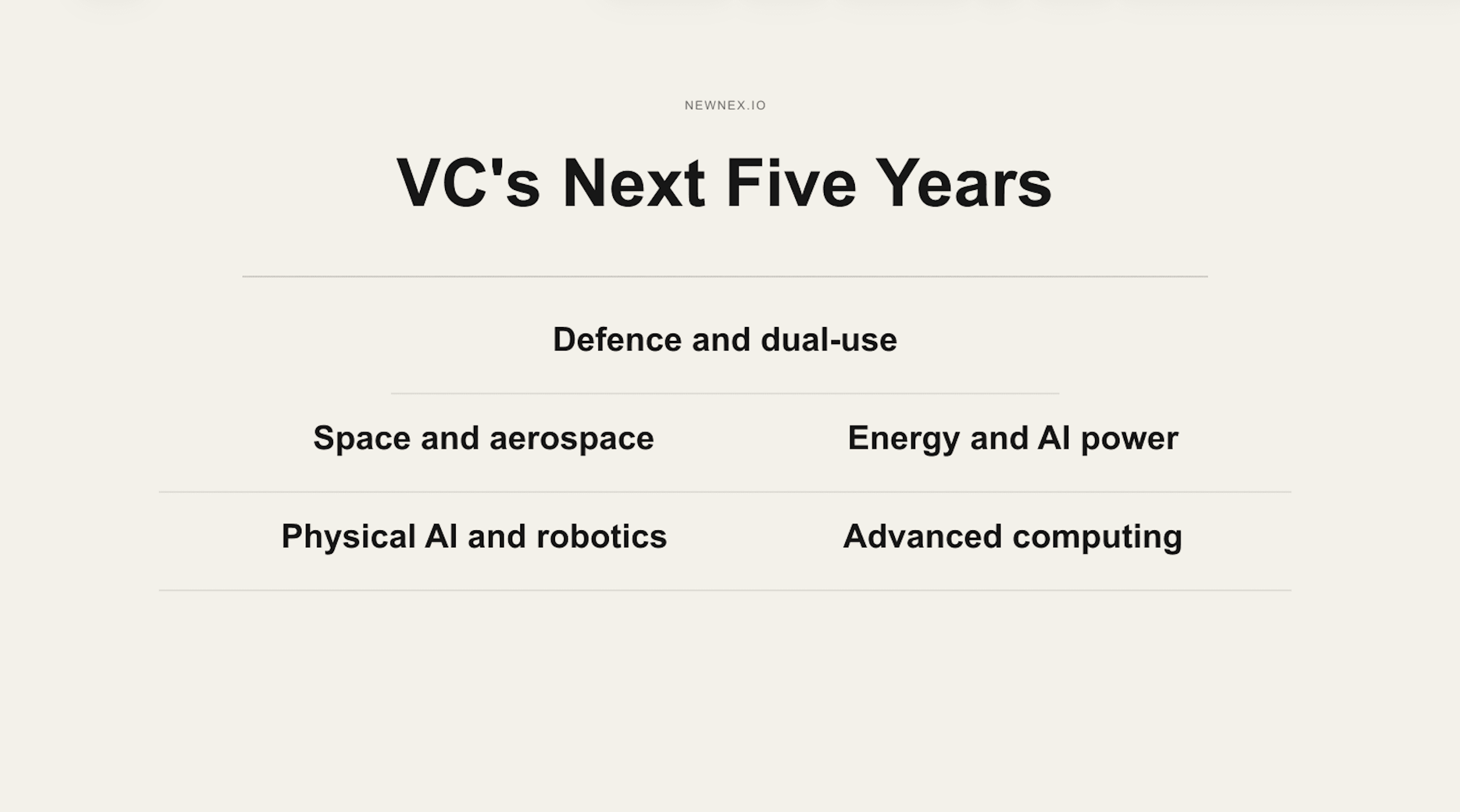
Defence and dual-use
Defence technology has moved from being a niche venture category to one of the most active areas of private-market interest.
The FT reported that defence-tech startups have raised $12.3bn in 2026, already above the $9.95bn raised in all of 2025. Anduril alone raised $5bn at a $61bn valuation and reported $2.2bn of revenue in 2025.
The reason is not simply that investors have become more comfortable with defence.
The underlying market has changed.
Wars in Ukraine and the Middle East have shown the need for cheaper, faster and more replaceable systems: drones, counter-drone technology, autonomous vessels, battlefield AI, secure communications and electronic warfare.
For venture investors, the test is not only whether the technology works.
The harder test is whether the company can move from prototype to procurement to repeated deployment.
That is where the real value will be built.
Space and aerospace
Space is changing too.
The opportunity is no longer only launch. Space is becoming part of the data, communications, defence and intelligence stack.
The global space economy is projected to reach $1.8tn by 2035. Space Capital data cited by MarketWatch showed $36bn invested in the space economy in Q1 2026, compared with $6.7bn a year earlier.
But investors should be conscious with the category label. A launch company, a satellite manufacturer, a geospatial analytics company and a defence intelligence platform are very different businesses.
The more interesting question is where space data becomes useful enough to enter daily workflows.
In defence, logistics, insurance, agriculture, climate monitoring and maritime security, the value is not only in collecting data from space. It is in turning that data into decisions quickly enough for customers to rely on it.
That is where space companies become harder to replace.
Energy and AI power
AI has made energy part of the technology stack.
JPMorgan estimates AI capital expenditure could reach $5.5tn by 2030, with $4.1tn financed through debt. Hyperscalers are expected to spend around $650bn in 2026 and more than $1.1tn in 2027.
The International Energy Agency expects global data-centre electricity use to rise from around 415 TWh in 2024 to 945 TWh by 2030.
This creates venture opportunities around onsite power, grid software, energy storage, advanced cooling, demand response, geothermal, nuclear-adjacent technologies, power electronics and AI energy optimisation.
The point is not simply that data centres need more MW capacity.
The more important issue is reliable power at the hours compute is needed.
A data centre without reliable power is not an AI asset. It is an expensive building waiting for infrastructure to catch up.
Physical AI and robotics
AI is moving from screens into the physical world.
Robotics and physical AI funding grew from $4.2bn in 2019 to $26bn in 2025, according to PitchBook data cited by the WSJ. By May 2026, the category had already raised more than $23bn.
This includes robotics, autonomous inspection, industrial automation, security systems, warehouse automation, medical robotics and field robotics for defence and energy.
The risk is that investors overpay for demos.
A good demo does not make a durable company.
In physical AI, the stronger companies will become part of the customer’s operating workflow. They will collect real-world data, improve through deployment and make the customer’s process faster, cheaper or safer.
That is a different underwriting problem from classic software.
Advanced computing
AI infrastructure is also creating opportunities around chips, memory, networking, photonics, cooling, edge inference and secure compute.
Advanced computing startups raised more than $20bn in 2026 year-to-date, compared with $28bn in all of 2025.
The question is not whether every startup can compete with Nvidia. Most cannot and most shouldn't.
The better question is where the bottleneck appears as AI moves from training to deployment.
Inference cost, memory bandwidth, energy efficiency, latency, secure edge compute and data-centre networking may all create room for specialist companies.
The investment lens
The next five years of venture will still include software.
But the most interesting opportunities may come where software gives an advantage inside harder markets.
Markets with physical constraints.
Markets with government demand.
Markets with infrastructure bottlenecks.
Markets where speed of deployment matters.
That means venture investors need a slightly different lens.
Can the company deploy in the real world?
Can it sell into customers with urgent problems?
Can it handle procurement, regulation and integration?
Can it improve through data after deployment?
Can it scale without losing control of cost, quality or reliability?
The best companies in defence, space, energy, physical AI and advanced computing will not look and feel like Saas anymore.
They may be more complex.
They may need more capital.
They may sell into slower customers.
But if they solve strategic bottlenecks, they can become very valuable.
The opportunity is no longer only software that scales.
It is technology that makes critical systems work better.
--
Newnex is an invite-only platform where institutional VCs share and syndicate deals privately, directly with other verified VCs. No open marketplace. No noise trusted institutional infrastructure.
Are you an institutional VC or Founder backed by a VC - get Access www.newnex.io