

May 2026
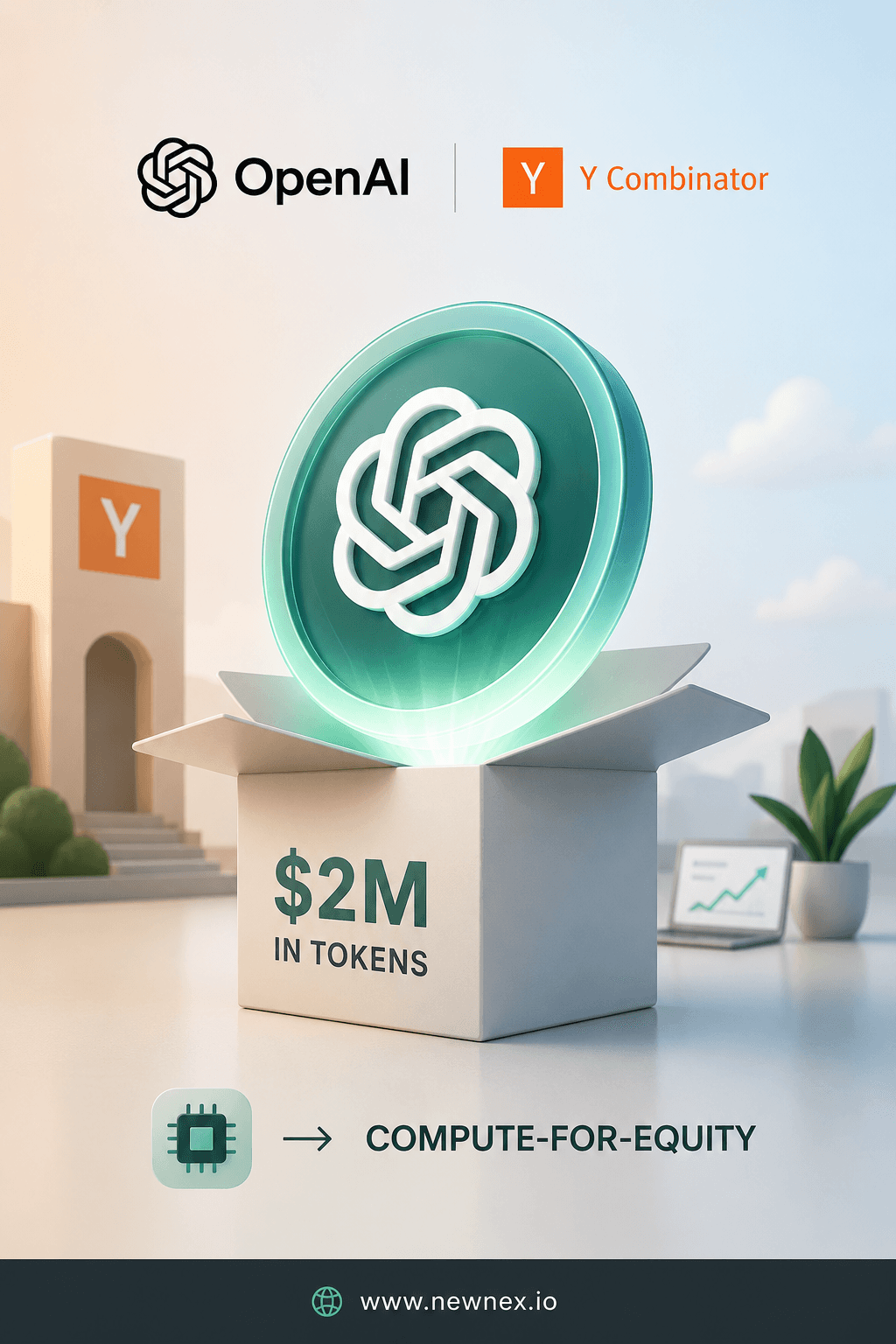
Late on Tuesday night, Sam Altman posted on X that OpenAI had offered to invest $2 million in tokens into every startup in the current Y Combinator batch. Not $2M in cash. $2M in OpenAI API credits, in exchange for equity.
YC partner Tyler Bosmeny called it a "mic drop moment." He wasn't wrong, but not for the reason most people read it. The headline is the number. The actual story is the structure: a foundation model lab buying equity in dozens of early-stage companies using its own inference capacity as the currency. That's not a credits program. That's venture capital, denominated in tokens.
This is the most explicit signal yet that the cash-for-equity model that defined the last fifty years of venture is being joined, and in some cases displaced, by something new. Resources themselves have become a fundable asset class.
What just happened
The mechanics are worth unpacking. OpenAI is not handing out promotional credits with a 12-month expiry, which is how its standard startup program works ($2,500 in API credits via VC referral, capped). This is a direct investment, with founders giving up real equity, and OpenAI funding it with tokens valued at retail price, meaning OpenAI's actual cost is a fraction of the $2M headline.
That last detail matters. If retail token pricing is, broadly, around five to ten times OpenAI's marginal compute cost, then OpenAI is acquiring meaningful equity stakes across an entire YC batch at a cost basis that would be impossible to match with cash. The startup gets real working capital it would otherwise have spent at OpenAI anyway. OpenAI gets ownership, lock-in, and a front-row seat to whatever the next cohort of AI-native companies ends up building.
The structural parallel some commentators have drawn is to Yuri Milner's old DST programme, which offered uniform investment terms to every YC startup. The crucial difference is that Milner was deploying dollars. Altman is deploying compute.
The real precedents: media-for-equity and services-for-equity
It is tempting to lump this in with cloud credits programs, but those are a different beast. AWS Activate, Google Cloud for Startups, and Microsoft for Startups have collectively pushed billions in credits to hundreds of thousands of companies since 2013, but in none of those cases does the cloud provider take equity. Credits flow through VC and accelerator partners; any equity stake sits with the VC. AWS is not on the cap table.
What Altman just did is structurally different, and the right precedents are older and from a different corner of the market.
Media-for-equity has been running for over fifteen years. German group ProSiebenSat.1 launched its media-for-equity arm back in 2009, swapping TV ad inventory for stakes in early-stage consumer companies. UK-based Channel 4 Ventures and a string of European broadcasters followed. The mechanics are exactly what OpenAI just adopted: a resource provider hands over inventory at retail value, takes shares directly, and benefits when the startup grows into a paying customer (or exits). Aggregate ad inventory deployed through media-for-equity funds across Europe now runs into the billions of euros, and the model has been used to seed companies like Zalando and Delivery Hero in their early days.
Services-for-equity is the other direct parallel. Law firms (Wilson Sonsini, Orrick), design agencies, recruiting firms and consultancies have for years taken equity in lieu of fees from early-stage startups. The principle is identical: the provider gives up the cash margin on services it would have provided anyway, in exchange for upside if the company wins.
Both models share three features that the OpenAI offer also has:
The provider takes shares directly, not through an intermediary.
The resource is valued at retail, even though the provider's marginal cost is much lower.
The provider has a strategic reason to want the startup to succeed beyond the equity stake itself. Broadcasters want more advertisers, law firms want growing clients, OpenAI wants more tokens consumed in production.
What is genuinely new is the scale and the resource. Media-for-equity deals are typically a few hundred thousand euros of ad inventory. Services-for-equity rarely exceeds a few hundred thousand dollars per startup. OpenAI just put $2M per startup across an entire YC batch on the table, and the resource is compute, which is the most strategically contested input in technology right now.
The cloud era proved that platforms could win the next generation of customers by subsidising their infrastructure. The AI era is showing that platforms can now buy equity in that next generation directly, using the same resource as currency.
Why tokens are the new strategic currency
What changed with the AI wave is the strategic weight of what is being given away.
Cloud storage is largely a commodity. GPU access and frontier model access are not. Once a startup builds on a given inference stack, switching is genuinely painful. Eval suites, prompt libraries, fine-tunes, latency profiles and reliability assumptions all carry forward. That has made AI inference one of the most contested levers in tech.
The OECD's 2025 review of AI venture activity found that AI firms working on IT infrastructure and hosting attracted USD 109.3 billion in venture investment in 2025 alone, more than two-thirds as much as all other industries combined. Compute has become an asset class in its own right. Handing some of it to early-stage startups in exchange for equity, ecosystem lock-in, or both is rational economic behaviour, not marketing fluff.
It also reflects competitive reality. Just four companies, OpenAI, Anthropic, xAI, and Waymo, collectively raised $188 billion in Q1 2026 alone, or 65% of all global venture investment in the quarter. With roughly 50% of all global venture funding in 2025 going to AI-related companies, and AI funding reaching $211 billion (up 85% year over year), every model provider and cloud is fighting to be the default substrate for the next cohort of category-defining startups. Tokens are now how they buy that position.
The expanding menu of "X for equity"
Cloud-for-credit and now tokens-for-equity are points on a longer continuum. Modern startups, especially in AI, need a stack of things money alone cannot easily buy:
Compute and GPU access, rationed even for well-funded teams.
Foundation model access, often with rate limits that take months of relationship-building to lift.
Distribution, into app stores, enterprise marketplaces, or partner channels.
Services, especially design, recruiting, legal and go-to-market.
Talent networks, including curated engineer and operator pools.
Media reach, where outlets and creators trade exposure for equity.
Each of these has produced its own X-for-equity model. Accelerators bundle mentorship and demo-day exposure with cash. European media-for-equity funds have been swapping ad inventory for shares since the late 2000s. Cloud and AI providers have now added infrastructure and inference to that menu, and at scale.
The result is that a typical seed-stage AI startup's "capital stack" looks very different from one a decade ago. The Series Seed cheque might be $2 to $4 million, but sitting alongside it might be $100K in AWS credits, $150K in Azure-plus-OpenAI via Microsoft for Startups, design partner deals with two enterprise customers, and now, if you happen to be in the current YC batch, $2M in OpenAI tokens for equity. The cash buys runway. The credits and tokens buy velocity.
The catch nobody is mentioning loudly
There is a sharper read on what OpenAI just did. The Information reported the offer at face value; commentary on X has been more divided. The skeptical reading: founders accepting $2M in tokens are letting OpenAI sit very close to whatever they build next. As one critic put it, there is a non-zero chance that OpenAI studies what these startups are doing, replicates the most promising ideas, and folds them into the free ChatGPT offering. This is the classic platform tension that ate developers on top of Twitter, Facebook, and many others before.
There are also harder questions about how this affects price discovery. If OpenAI is investing at $2M token retail value but its marginal cost is a fraction of that, what's the real equity-for-value ratio? Founders accepting the deal need to understand they are selling equity priced against retail token pricing, not against OpenAI's cost basis.
And finally: credits expire. OpenAI's pre-paid and program credits expire 12 months after issuance with no extensions. The $2M is a free trial with a hard deadline. Production usage that follows is the actual business OpenAI is buying into.
What founders should actually do
A few practical observations:
Treat credits as a capital strategy, not a side benefit. For an AI-native company, the difference between a startup that has stacked $300K to $500K in cloud and AI credits and one that has not is often six months of runway. Now layer the YC-batch token offer on top, and you can see why ecosystem positioning has become a competitive variable.
The gating mechanism is usually a VC referral. Most of the larger tiers, AWS Portfolio, OpenAI Grove, the higher Microsoft and Google bands, and now token-for-equity offers like this one, are gated behind VC and accelerator partnerships. This makes investor selection partly a credits-access decision.
Read the equity terms, not just the headline. A $2M token investment for equity is fundamentally different from a $2M cash cheque. Model the dilution assuming credits are worth their cost basis, not their retail price.
Do not confuse the trial with the contract. Credits buy you time on someone else's infrastructure at zero marginal cost. The day they expire, your unit economics need to work at full retail. Founders who build assuming credit pricing get brutal surprises in month thirteen.
A more vertically integrated venture market
Step back and the picture is clearer. The venture ecosystem of 2026 is more collaborative, more resource-driven, and more vertically integrated than the cash-for-equity world of even five years ago. Investors and platforms increasingly compete on what they can do for a startup, not just how much they will write into it.
The cash-for-equity model is alive. The largest cheques still come in dollars. But around that core, a parallel economy has matured: media-for-equity, services-for-equity, distribution-for-equity, and now, most strikingly, tokens-for-equity, at venture round size, from the most valuable AI company in the world. Cloud credits sit alongside this as a related but distinct model: subsidised resources without an equity exchange, designed to win the customer rather than buy a stake.
The right question for founders is no longer how much can I raise? It is how much capital, plus how much compute, plus how much distribution, plus which strategic relationships can I assemble? The answer to that combined question, more than the raw cheque size, increasingly determines who wins.
OpenAI just made that explicit. Expect Anthropic, Google, and the rest to respond in kind within the year.
Figures cited for AWS Activate, OpenAI startup programs, and AI venture funding totals reflect publicly reported program details and Crunchbase/OECD data as of mid-2026. Specific eligibility criteria and credit amounts change frequently. Always check directly with the provider before planning around any specific number.
Newnex is an invite-only platform where institutional VCs share and syndicate deals privately, directly with other verified VCs. No open marketplace. No noise. Just trusted co-investment infrastructure.
Get Access www.newnex.io