

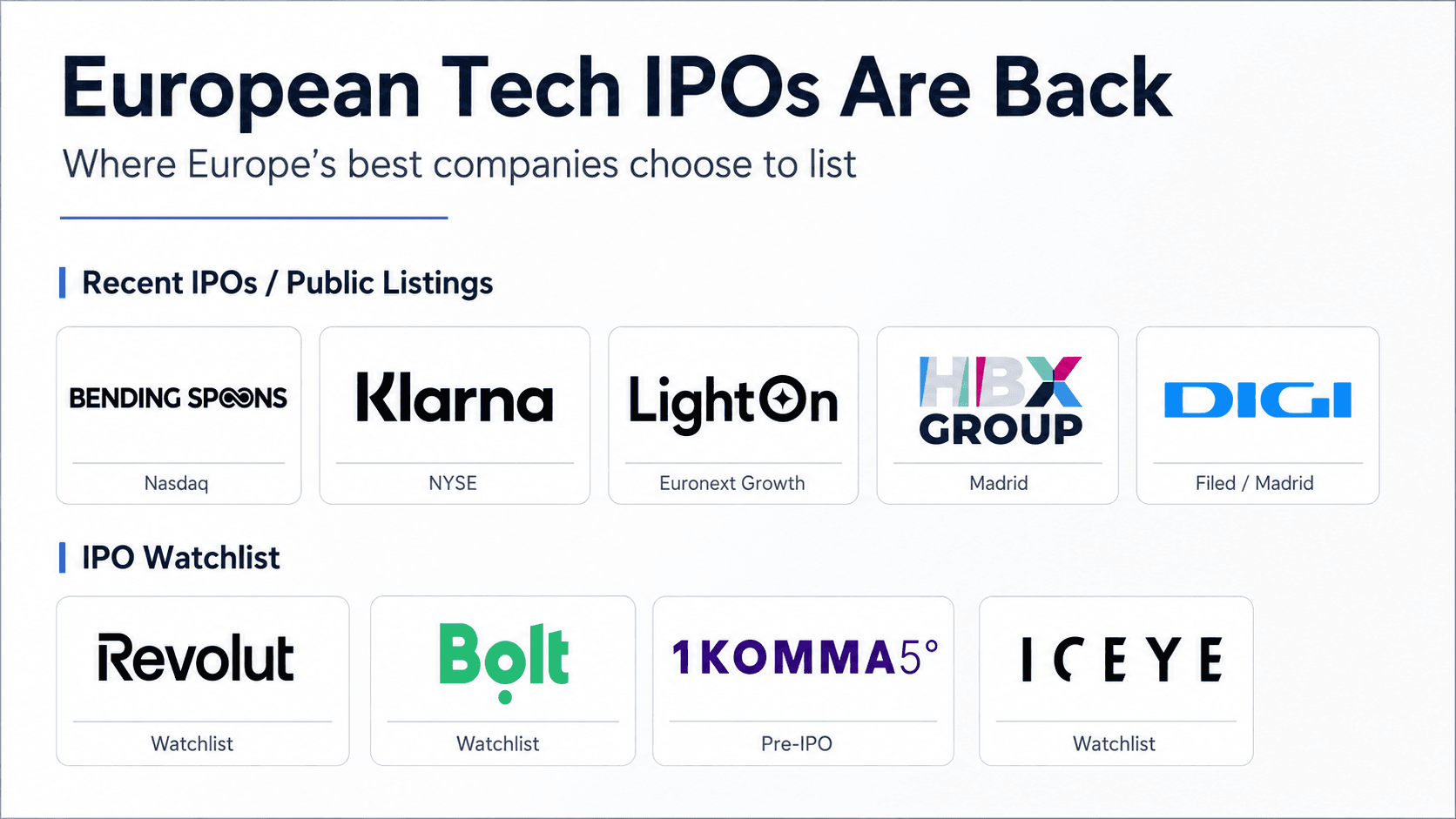
European IPO activity is showing signs of recovery after several subdued years. But the rebound is not simply about more companies going public. The more important story is strategic: Europe is producing increasingly mature software, fintech, AI, climate-tech and deep-tech companies, yet many of the most ambitious names are still looking to U.S. markets for deeper liquidity, stronger analyst coverage and a larger investor base.
The data supports the recovery narrative, but also shows how selective the market has become. In 2025, European IPO volume fell by 20% to 105 deals (EY's count of all priced listings, including smaller growth-market offerings), with proceeds down 10% to $17.3bn. Strip out the long tail of small-cap listings and the picture is thinner still: Bloomberg data shows just 47 European IPOs priced in the first nine months of 2025, near a 20-year low, with the region's median deal size well below its pre-pandemic average. However, momentum improved into late 2025 and carried into 2026. In Q1 2026, European IPO markets raised €4.7bn across 12 IPOs, up 47% in proceeds versus Q1 2025, while EMEA IPO proceeds reached $7.4bn across 34 IPOs, up 30% year on year.
This is not a broad reopening for every venture-backed company. It is a quality window. Investors are rewarding companies with scale, resilience, profitability visibility and sector relevance. EY's Q1 2026 IPO review noted that global proceeds rose sharply despite a decline in overall IPO count, showing that capital is concentrating in fewer, larger and more mature issuers.
The U.S. Pull: Liquidity, AI Exuberance and Global Investor Depth
The strongest signal is the continued gravitational pull of U.S. exchanges. Nasdaq reported its strongest first half in U.S. exchange history in 2026, with $129.3bn raised from new listings, led by SpaceX's record-breaking IPO in June. Nasdaq also highlighted AI, chips, space, biotech, quantum computing and infrastructure as major listing themes.
For European founders and shareholders, this matters. The U.S. market offers a deeper pool of specialist tech investors, broader institutional coverage, stronger index inclusion potential and higher trading liquidity. This is why the European debate is no longer just "IPO or stay private"; it is increasingly "Europe, New York, Nasdaq, SPAC, secondary, or dual-track?"
Bending Spoons is the clearest recent example. The Milan-based software company listed on Nasdaq on July 1, 2026, raising approximately $1.68bn, with shares closing almost 40% above the IPO price on debut, valuing the company near $25bn at close. Its success is important because it validates Europe's ability to produce scaled software platforms, but it also reinforces the reality that many European champions still see U.S. public markets as the best venue for global scale.
Klarna tells a similar, more complicated story. The Swedish fintech listed on the New York Stock Exchange in September 2025, priced at $40/share, opened at $52/share, and reached a valuation of around $20bn on its first trading day. That listing became a bellwether for whether European fintech could still attract global public-market appetite after the valuation reset of 2022-2023. The debut was strong, but the aftermarket has not held up: by mid-2026 Klarna shares had fallen more than 50% from their IPO price as investors scrutinised the company's path to sustained profitability. The lesson for founders and boards weighing a U.S. listing is not just about the pop on day one; it is about whether the business can support the multiple once the initial enthusiasm fades.
Europe Is Still Producing Public-Market Candidates
The IPO pipeline is not empty. It is just more disciplined.
Revolut remains one of Europe's most closely watched future IPO candidates. Its $75bn secondary valuation was supported by strong operating momentum: 2024 revenue grew 72% to $4.0bn, profit before tax rose 149% to $1.4bn, and its customer base surpassed 65m in 2025. But this is not an imminent IPO. CEO Nik Storonsky said in April 2026 that a listing is roughly two years away, putting the earliest realistic window at 2028, with the company reportedly targeting a valuation as high as $150-200bn when it does list.
Bolt is also widely discussed as a potential IPO candidate, but no formal listing has been filed. The more accurate framing is that Bolt is preparing the business to be IPO-ready, while weighing market conditions and potential listing venues between Europe and the U.S.
In climate tech, 1KOMMA5° is a credible watchlist name. The Hamburg-based home electrification and energy software company extended its €150m pre-IPO funding round in 2025, with capital aimed at scaling its Heartbeat AI energy management software and virtual power plant platform.
In deep tech and space, ICEYE is one of Europe's most important private companies. Its June 2026 funding round raised €450m in primary capital, with the total transaction including secondary exceeding €1bn, valuing the company above €10bn. That makes ICEYE a serious future IPO candidate, but it should be described as "IPO watchlist" rather than "IPO filed."
Europe's Own Exchanges Are Still Irrelevant
It would be wrong to suggest that all meaningful European listings are moving to the U.S. HBX Group, the owner of Hotelbeds, listed on Spanish exchanges in February 2025 at a €2.84bn market capitalisation, with the total operation (including overallotment and secondary sales) worth around €860m. Digi Communications has also filed to float its Spanish subsidiary, Digi Spain Telecom, on the Madrid, Barcelona, Bilbao and Valencia exchanges, at a pre-money valuation of up to €1.7bn, showing that sector leaders with domestic relevance can still choose European venues.
LightOn is another important case, even though it is much smaller. The Paris-based GenAI company listed on Euronext Growth in November 2024, raising €11.9m at a €62m market capitalisation. Symbolically, it mattered because it gave Europe one of its first pure-play listed GenAI companies.
The challenge is scale. Europe can host IPOs, but it still struggles to consistently retain the highest-growth, globally ambitious tech companies at the public-market stage. Atomico's analysis captures this structural issue: Europe generates 17% of new global enterprise value but captures only 10% of exit value.
Secondaries and SPACs Are Becoming Part of the Exit Stack
The IPO is no longer the only path to liquidity.
Private secondary markets have become a major release valve for employees, founders and early investors, at least in the U.S. market, where the data is most complete. U.S. VC secondary transaction value reached an estimated $61.1bn in the 12 months ending June 2025, surpassing the combined value of U.S. VC-backed IPOs over the same period at $58.8bn, according to Carta and PitchBook data. Comparable European figures are less consolidated, but the same liquidity pressure, longer private lifecycles, thinner IPO windows, is playing out here too.
SPACs are also back, but in a more selective form than the 2020-2021 boom. Globally, 44 SPAC mergers worth $36.9bn had been announced in 2026 by mid-June, compared with 33 deals worth $15bn at the same point the previous year, according to Dealogic. There were also 359 SPACs sitting on $56.8bn of undeployed capital as of mid-June, according to SPAC Research.
For European deep-tech companies, the U.S. SPAC route is especially relevant. Nine European startups with a combined value of at least $12.3bn have announced plans in 2026 to merge with U.S.-listed SPACs, the highest annual tally since 2021. This is particularly visible in nuclear, quantum, space, defence and other capital-intensive sectors, with quantum computing names like Pasqal among those choosing the SPAC route this year.
European IPO activity is rebounding, but it is not a return to easy-money public markets. It is a selective reopening for companies that can demonstrate scale, strong fundamentals, sector relevance and credible public-company readiness, and the aftermarket performance of recent debuts, Klarna included, is a reminder that a strong first day is not the same as a durable valuation.
The strongest European companies now have more exit options than before: Nasdaq, NYSE, Euronext, London, Madrid, secondary sales, SPACs and dual-track M&A processes. That is positive for founders and shareholders, but it creates a strategic challenge for Europe. If Europe wants to capture more of the value it creates, it must not only fund startups earlier; it must also build the capital-market depth to keep them listed, liquid and globally competitive from Europe.
The next phase of European tech will therefore be judged not only by how many unicorns it creates, but by where those companies choose to go public, and who captures the upside when they do.
--
Newnex is where institutional VCs syndicate deals and introduce follow-on rounds to each other directly, privately without intermediaries. 65+ VCs across Europe, the US and India, spanning early to growth stage. Apply to join: www.newnex.io